Yes, jade is scientifically classified as a gemstone comprising two distinct minerals—nephrite and jadeite. Both meet key gemological criteria through their beauty, durability (ranking 6-7 on Mohs scale), and rarity. Valued globally for centuries in jewelry and carvings, jade's microcrystalline structure contributes to its unique toughness and vitreous-to-greasy luster that distinguishes it from ordinary stones.
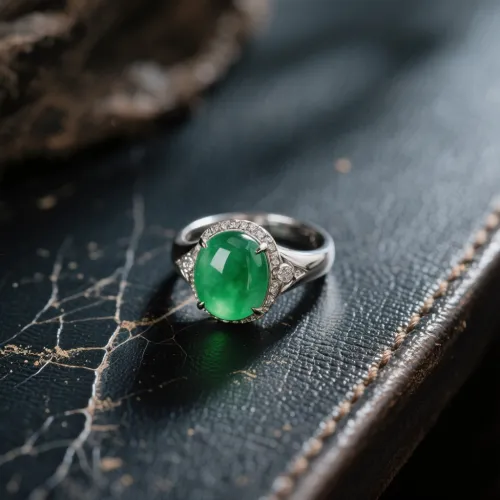
Picture standing before a crowded gem market stall: three similar green stones labeled as jade, serpentine, and quartz. The seller challenges you to identify the real gemstone—a moment when suddenly knowing jade’s true nature impacts both pride and pocket. Why does confusion like this happen so often? Because understanding jade requires navigating overlapping mineral science, cultural assumptions, and commercial realities. This guide distills the complexity into actionable insights through these key facets:
This first aspect addresses why mineralogists universally recognize jade as a gemstone—not merely a cultural artifact. Let's clarify what pushes certain minerals into the gem category.
Traditional gemology requires three attributes: beauty for ornamentation, sufficient durability for long-term use (typically Mohs 6+ hardness), and relative rarity. Nephrite, found across Russia and Canada, exhibits remarkable toughness through its fibrous calcium magnesium silicate crystals. Jadeite, predominantly mined in Myanmar, demonstrates higher translucency via granular sodium aluminum silicate structures while maintaining impressive chip resistance.
Imagine comparing jade to surrounding rocks at its geological point of origin—serpentine lacks comparable toughness, quartz falls short in texture and lustre. Only nephrite and jadeite develop the microcrystalline interlocking that yields that characteristic waxy glow after polishing, combined with sufficient hardness. This structural uniqueness explains why lapidarists have treasured it since Neolithic times.
These scenarios highlight why identification matters—connecting abstract classifications to tangible experiences like shopping, inheriting, or appraising pieces.
Hesitating over a jade listing with wildly varying prices? You’re right to question inconsistencies. True jade's value reflects specific characteristics: check color distribution first. Uneven "zoning"—like concentrated green patches near cracks—often indicates low-grade dyed material rather than chromium or iron-tinted natural hues. Authentic pieces should exhibit consistent translucency without artificial cloudiness.
That smooth green pendant from your aunt might spark family debates. To gauge authenticity non-invasively: hold it against your skin. Natural jade tends to retain coolness longer than glass imitations due to its density and thermal properties. Next, tap it gently with a metal pin; authentic pieces produce clear high-pitched notes unlike plastic or poor composites.
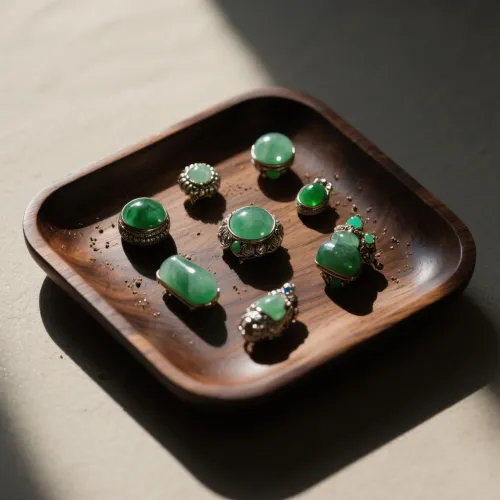
Understanding how jade forms reveals why its properties differ from look-alikes—knowledge that transforms market encounters.
Picture oceanic plates colliding deep beneath mountains: these subduction zones create the extreme heat and pressure that transform minerals into true jade over millennia. Nephrite jade typically forms within altered serpentinite rock, while jadeite emerges in metamorphic environments with high sodium content, creating distinct crystalline architectures visible under magnification.
Why can jade withstand carving impacts that shatter materials with similar hardness? Microscopic examination reveals the answer: nephrite’s matted fibrous crystals interlock like organic fabrics, absorbing energy along thousands of microscopic planes. Jadeite’s granular structure diffuses force differently yet effectively—explaining ancient carvers’ ability to shape intricate dragons and rings while resisting shock-based fractures.
This section trains your eyes and fingers to notice authentic diagnostic features—transforming passive observation into informed judgment.
Notice how museum-grade jadeite diffuses light internally like sunlight through shallow seawater? This translucency comes from tightly packed crystal boundaries minimizing light scattering. Nephrite typically shows more turbid illumination due to longer fibrous structures. Surface reflection delivers another clue: natural jade’s polish creates greasy or waxy luster rather than glass-like sparkle.
A common market trick involves assessing weight: genuine jade feels heavier than serpentine or glass. Run your thumb across polished surfaces too—authentic pieces maintain smooth transitions since repairs often leave rippled zones. If permitted, test thermal conductivity: high-density jade stays cooler than plastic simulants long after being held.
Applying knowledge at critical moments—whether buying, inheriting, or preserving jade—requires practical protocols.
When considering valuable jadeite, insist on gem lab certificates verifying refractive index (1.60-1.67) and specific gravity (2.9-3.38), key mineral signatures separating it from substitutes. For carvings or antique beads lacking paperwork, examine crevices under 10x magnification: dyed simulants often concentrate color in fractures, showing unnatural pooling.
While jade withstands impacts better than many gems, daily care matters. Store pieces separately from quartz or diamonds whose hardness can scratch polished surfaces over years—use fabric-lined compartments. Clean with mild soap and lukewarm water only, avoiding chemical treatments or ultrasonic cleansers that may compromise natural textures.
Jade’s journey from geological formation to cultural treasure reveals humanity’s persistent fascination.
Ming dynasty artisans demonstrated jade’s carving viability through intricate bi-disks and pendants—impossible with similarly hard but brittle materials. Pre-Columbian Olmecs similarly shaped ceremonial axes, proving nephrite’s global workability. This durability made it functional beyond mere ornamentation: Maori toki adzes and Chinese scholar objects endured generations of use.
Auction results reveal fascinating patterns: imperial jadeite's vibrant greens command premiums while subtly-toned nephrite artifacts gain historical collector interest. Unlike diamonds where brilliance dominates evaluation, high-value jade prioritizes even translucency, texture consistency, and natural color saturation.
Now picture yourself confidently examining that marketplace trio—here’s your distilled decision framework:
Next time you encounter jade—in museums, shops, or family collections—pause to notice those three characteristics emerging. How might subtle features you previously missed shift your perception?
What distinguishes nephrite from jadeite?
Nephrite typically exhibits fibrous structures creating toughness while jadeite’s granular crystals enable higher translucency—both form under different geological conditions.
Why do some jade pieces feel warmer?
Less dense simulants like soapstone reach skin temperature faster; authentic jade typically retains coolness longer due to superior thermal properties.
Can jade withstand daily wear?
Moderate hardness (Mohs 6-7) makes it suitable for occasional jewelry though long-term abrasion may cause gradual polish degradation.


$
