In Taoism, jade embodies cosmic balance through Yin-Yang harmony—its physical properties mirror universal opposites interacting in equilibrium. The stone's exceptional durability (6-7 Mohs scale) represents eternal cosmic order, while its purity reflects natural harmony. Ancient artisans crafted ritual objects like circular bi discs and square cong tubes from jade to align human actions with celestial energies, creating a tangible bridge between earthly and cosmic realms.

Picture this: You're hesitating between two jade pendants online—one pale green, one deep emerald—wondering which embodies true Yin-Yang essence. Like this shopping dilemma, understanding jade's cosmic symbolism requires navigating layered meanings. That's why we'll break it into practical checks: Rather than mystical claims, you'll get observable signals and ritual context to recognize how a simple stone became Taoism's eternal balance metaphor. Consider this your field guide to spotting cosmic harmony in tangible jade traits.
Jade breathes abstract Taoism concepts into touchable reality. This check decodes how physics becomes philosophy—your lens to see cosmic balance in everyday jade observations like summer's warmth sliding off grandma's cool heirloom bracelet.
Jade's distinctive tactile qualities reveal why it embodies Taoist ideals. Run your thumb across authentic nephrite; the signature waxy texture without artificial gloss suggests ancient polishing methods used for ceremonial objects. More profoundly, the stone's thermal behavior—its resistance to warming even when held in your palm—demonstrates density properties that Taoist practitioners interpreted as cosmic permanence. This cool touch was historically thought to contain celestial energies.
Veins and inclusions in jade aren't flaws to Taoists but cosmic poetry. Under magnification, irregular mineral patterns represent nature's unbalanced beauty harmonized within the stone—what practitioners call "necessary coexistence of opposites." Pieces with natural cloud-like formations especially resonate with Taoism's wu wei principle as they appear effortlessly formed. Jade's metamorphic origins matter too: Born under extreme tectonic pressure, its geological story mirrors Taoism's transformation principles.
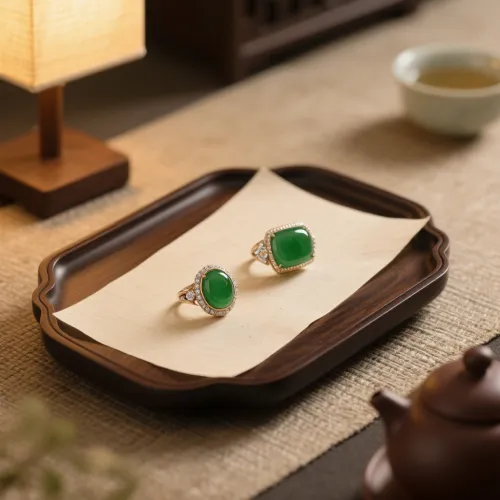
Remember puzzling over twin carvings at a night market with wildly different prices? This check equips you to decode spiritual authenticity through physics. We'll translate observable traits into cosmic language without mystical jargon—grounding ancient symbolism in material reality.
Mild translucency captures Taoism's spiritual permeability. Hold jade near natural light: Quality nephrite reveals inner glow varying with carving thickness—a fine grain structure symbolizing purity. Avoid neon-bright stones; muted greens mirror nephrite's natural origins, while darker green stones carry more yang energy in Five Phases theory. Carvings with both angular and circular elements visually balance heaven and earth symbolism.
Consider dragon-phoenix pendants where two creatures share one jade—a visual metaphor for opposing forces needing each other historically used to mediate cosmic tensions. Bi discs (circular heaven symbols) and cong tubes (square earth symbols) physically manifest this duality too. Even color zoning acts as miniature ecosystem: Gray-green transitions represent fluid exchanges like mountain mist meeting forest canopy within one stone.
After receiving cracked jade during personal turmoil, discovering Taoism views fractures as part of cosmic unity changes everything. This check moves from observation to action—how to select, care for, and position jade as contemporary totems of balance.
Prioritize carvings integrating circular/angular forms to visually balance heaven-earth energies. Leaf motifs symbolize Taoism's effortless natural alignment, while designs accepting inclusions as "landscapes within stone" reflect perfect cosmic imperfection. For gifting, white "mutton fat" nephrite embodies primal unity—its undifferentiated purity resonating with Taoism's primordial chaos before dualities emerged.
When Taoist masters buried jade with the deceased, they weren't just interring gemstones—they planted conduits between cosmic realms. This check uncovers how imperial workshops turned geological marvel into spiritual technology now echoed in contemporary symbolism.
Square cong tubes represented earth's stability while circular bi discs mirrored heaven's cycles—together forming ritual fulcrums where human ceremonies balanced cosmic forces. Jade's tomb role as spirit conduit leveraged its physical resilience to outlast mortal flesh plus its light-permeable nature suggesting permeability between realms. Modern carvings preserve this legacy; even a simple pendant becomes miniature ritual object when chosen consciously.
Next time you hold jade or browse pieces online, remember these anchors: 1) Seek circular+angular balance in carvings 2) Notice temperature-resisting coolness 3) Read cloud-like inclusions as cosmic poetry 4) Honor muted natural greens over neon hues 5) Clean gently, avoiding thermal shocks. Imagine you're back observing those marketplace pendants: Which subtle cosmic signatures now stand out? Trust that awareness to guide meaningful connections.
Q: What does Ying Yang jade mean?
A: Yin-yang jade refers to pieces visually or energetically embodying duality in harmony—like dragon-phoenix carvings or stones showing balanced green/white zoning representing interdependence.
Q: Is darker green jade more yang?
A: Darker greens often carry higher yang qualities in Taoism's Five Phases system, while paler stones tend yin—yet the essence lies in their interaction rather than absolute values.
Q: Why do Taoists rub jade during meditation?
A: Tactile focus on jade's cool, smooth texture physically anchors practitioners while its symbolic weight recalls cosmic unity—no supernatural claims, just sensory mindfulness of universal principles.


$
