Mineral crystals like olivine, irregular internal fractures, and organic color banding signal untreated jade. These natural imperfections form during stone formation and are distinct from treated jade's artificial fillings or dye residues. Spotting such features helps confirm a jade's unenhanced status.

Imagine discovering your grandfather's jade pendant after decades in storage. As you examine its subtle cracks under lamplight, doubts about its authenticity surface – much like that traveler who questioned a "pure jade" bracelet bought from a bustling market. These moments spark our need for clarity. Rather than drowning in gemology texts, this guide distills the microscopic telltales into a practical checklist for everyday encounters. You'll learn to decode nature's signatures whether you're examining inherited treasures, online purchases, or market finds.
Understanding geological origins helps us appreciate why inclusions serve as reliable authenticity markers. This section explores how 200-million-year processes create jade's microscopic fingerprint.
Mineral crystals like olivine become trapped as jade solidifies under extreme heat and pressure. Picture molten rock cooling within mountain ranges, crystallizing foreign particles in suspended animation. As Burmese jade forms near chromite deposits, for instance, chromite crystals become permanent residents within its structure.
Earth's tectonic movements create stress fractures with characteristically chaotic paths. Unlike the uniform cracks in treated stones, natural fractures resemble frost patterns on a winter window – delicate, branching, and uniquely organic. Key identifiers to notice:
Separating natural characteristics from enhancement artifacts reveals jade's true story. Learn to spot these visual contrasts during examinations.
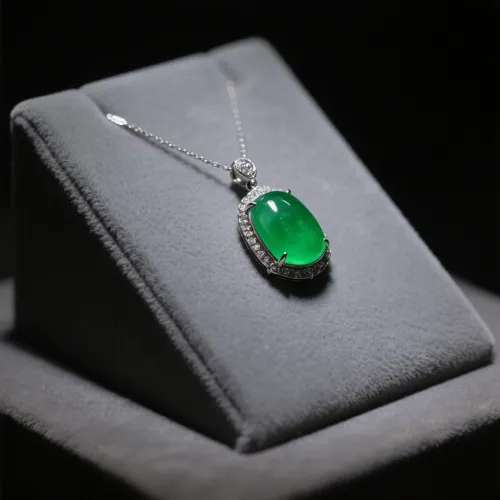
Authentic jade's color progresses like sunset gradients flowing through clouds. Mineral banding creates subtle transitions between green hues, whereas dyed jade often displays unnaturally uniform pigmentation with abrupt edges. At a Bangkok gem market last summer, a vendor demonstrated how dye pools accumulate around surface fractures – visible through a simple loupe.
Picture tree sap oozing through bark cracks. Similar principles apply when resin fills natural fractures to enhance clarity and stability. These artificial applications often create glossy fill lines that feel unnaturally smooth under micro-scrutiny. Under UV light, treated jade reveals secrets: resin emits characteristic blue-green fluorescence. Compare these cues with untreated stones' matte fractures:
Implement field-tested approaches to analyze potential jade wherever you encounter it, from market stalls to family collections.
A simple 10x loupe becomes your detective lens. Position jade near north-facing daylight to spot inclusions: crystalline formations resemble grains of sand frozen mid-movement, while feathering fractures branch like river deltas. Avoid artificial lighting's deceptive warmth, especially when examining color distribution. I recall a novice collector discovering this during a gem club meeting – shifting locations revealed inconsistent dye patterns unnoticed minutes earlier.
Engraving valleys and clasp settings become inclusion hideouts. Rotate pieces slowly under light, observing edge transitions where untreated stone typically retains natural cloudiness. Pro tip: compare pieces simultaneously. Differences in fracture glossiness or color uniformity often surface through direct comparison.
Common questions surface about whether inclusions diminish or validate jade's worth. This section separates fact from fiction.
Contrary to intuition, authentic imperfections often enhance value by confirming natural origins. Collector circles nickname internal mineralization "nature's signature" – unique markers increasing certain pieces' uniqueness. However, fractures compromising structural integrity do lower worth. The valuation sweet spot exists where inclusions validate authenticity without weakening functionality.
Thermal-sensitive inclusions can undergo permanent changes. High temperatures may cause micro-fractures to expand or crystal formations to develop hazy boundaries. Remember that family heirloom rediscovery scene? Protective storage away from sunlight and radiators preserves these microscopic time capsules.
When examining potential jade in any setting, remember these condensed principles:
First – look for mineral grains resembling trapped sand under magnification. Second – trace fractures' irregular paths and matte textures. Third – seek subtle color transitions instead of artificial uniformity. Fourth – notice edge cloudiness rather than perfect clarity. Finally – when possible, compare multiple specimens side-by-side. These observable truths reveal what grand formations cannot.
Q: Can inclusions be seen without magnification tools?
A: Mineral clusters and major fractures may be visible as cloudy formations when backlit, though smaller features require 10x loupe examination.
Q: Are feathered fractures reliable authenticity markers?
A: Yes, when appearing with jagged edges and matte finish, as resin treatments create different fracture patterns.
Q: How does nephrite differ in inclusion characteristics?
A: Nephrite typically displays fibrous, interlocking structures rather than jadeite's granular crystal formations.
Q: Why do some Burmese jade pieces contain chromite?
A: Chromite deposits occur naturally in Burma's geological environment where jade forms, creating distinct regional signatures.


$
